Even behind the Iron Curtain, he was able to create drama comparable to the Tour de France. In the 1970s, Polish rider Ryszard Szurkowski was the king of the amateur peloton, winning the Peace Race four times and claiming thirteen stage victories.
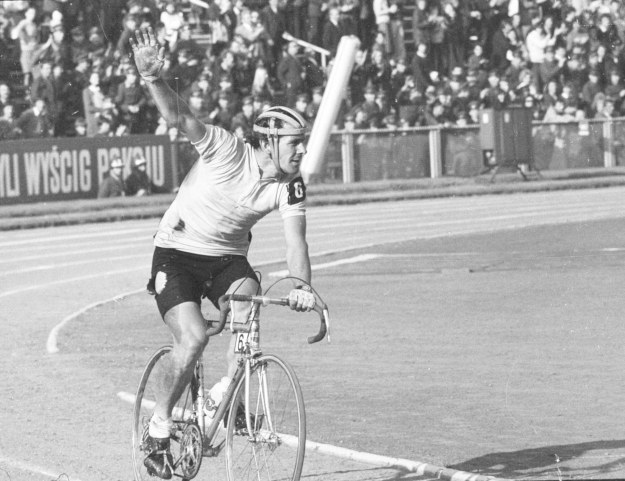
Born in the village of Świebodów, Szurkowski embodied versatility, strength and elegance. In his era, he was a true phenomenon.
His name is inseparably linked with the legendary Peace Race. At a time when the event represented the pinnacle of amateur cycling, Szurkowski won it four times — in 1970, 1971, 1973 and 1975. Only Steffen Wesemann, with five overall victories, was more successful.
On top of that, Ryszard Szurkowski collected an astonishing 13 stage wins, placing him among the most successful riders in the history of the race. In the all-time rankings for stage victories, he stands fifth, behind Olaf Ludwig, who tops the list with 38.
The Champ without limits
The dominance of the Polish star was built on far more than physical power. It was a combination of tactical maturity, an instinctive ability to read a race and a team spirit that made him a natural leader.
Szurkowski was, however, much more than “just” a stage-race specialist. At a time when most riders tended to specialise narrowly, he crossed the boundaries between disciplines. He competed successfully in cyclo-cross and also won Polish national titles in both the individual road race and the team event. It was precisely this versatility that made him such an exceptional figure — a rider capable of handling technical off-road sections just as confidently as long, tactically demanding road stages.
His qualities were also fully evident on the Olympic stage. At the 1972 Munich Games, he won a silver medal in the team road race. Four years later in Montreal, he helped the Polish quartet to another silver in the team event. In the individual road race in Canada, he finished twelfth. Those Olympic medals were proof that Szurkowski belonged among the absolute world elite, regardless of the era’s division between amateurs and professionals.
Self-taught, then a successful coach
When his racing career ended, he did not disappear from the scene. On the contrary, his influence continued in his role as a coach and mentor. Although he had largely been self-taught as a rider, he became remarkably successful as a coach. His racing experience, tactical insight and ability to work with a team made him a respected figure even off the bike. He led the Polish national team for six years. Under his guidance, Lech Piasecki achieved major success, winning both the Peace Race and the World Championship in 1985.
Yet fate was not always kind to this giant of the sport. In 2018, he suffered a serious spinal injury in a crash during an amateur race, which left him confined to a wheelchair. For a man whose life had been defined by movement, speed and freedom, it was a cruel blow.
The story of Ryszard Szurkowski is a reminder of a time when cycling had a different face, but the same kind of heroes. Men who could win — and inspire at the same time.
Reprophoto: Zbigniew Matuszewski / PAP